Quick Facts:
Topic: UK Personal Independence Payment (PIP) 2027/28 rate increase, the Timms Review, and accessible travel support
Key Dates: Timms Review published 24 November 2026; 3.5% rate rise takes effect from 12 April 2027
Location: England and Wales (Scotland uses Adult Disability Payment)
Best For: UK disabled travellers, people managing hidden disabilities or long-term recovery, and anyone planning accessible UK or international trips
Travelling with a disability often comes with an invisible price tag. From booking step-free hotel rooms and private accessible airport transfers to paying higher travel insurance premiums or pacing an itinerary around fatigue, exploring the world takes more planning—and usually costs more.
For millions of people in England and Wales, Personal Independence Payment (PIP) plays a vital role in bridging that gap. With two major updates landing in November 2026—a confirmed 3.5% rate rise for April 2027 and the publication of Sir Stephen Timms’ landmark review of PIP—here is what is changing, what stays the same, and what it means for disabled travellers.
Confirmed for April 2027: The 3.5% PIP Rate Rise
Following the Department for Work and Pensions’ (DWP) November 2026 publication of proposed benefit rates—linked to September 2026’s 3.5% CPI inflation figure—PIP payments in England and Wales are set to rise automatically from 12 April 2027 once Parliament approves the Up-rating Order.
You do not need to reapply or contact the DWP; the new rates will be applied automatically.
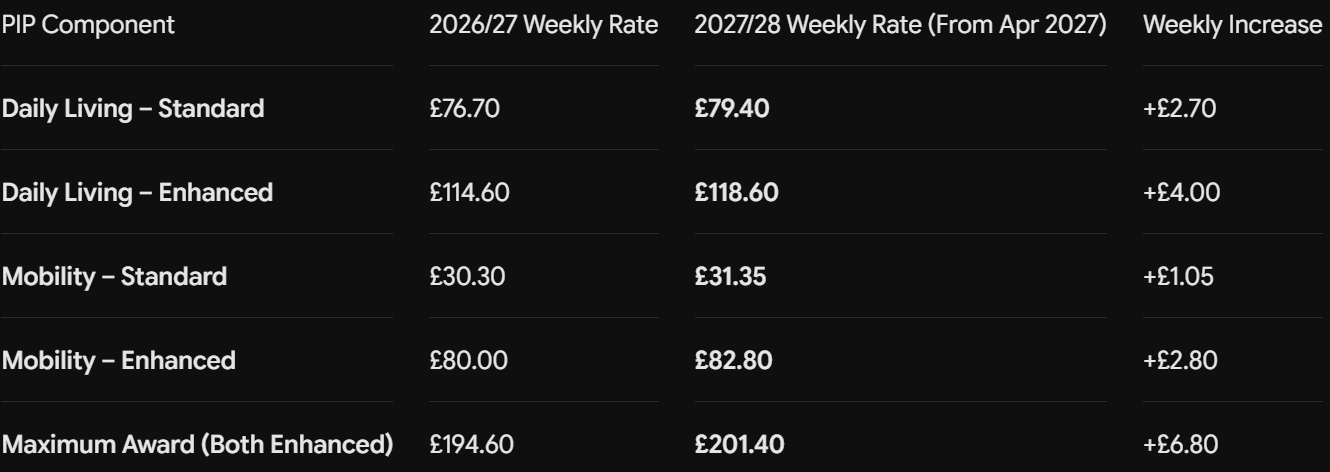
What this means in real terms: Someone receiving the maximum award will receive £805.60 every four weeks (£10,472.80 per year). Because PIP is paid every four weeks in arrears, the first full payment at the new rate will typically arrive in late April or May 2027. While an inflation-linked rise won't feel like a windfall, it confirms that PIP is neither frozen nor cut heading into 2027.
2. The Timms Review: Rehumanising PIP
Alongside the April 2027 rates, Sir Stephen Timms’ long-awaited review of PIP—co-produced with disabled people’s organisations—was published on 24 November 2026. Calling for a fundamental overhaul to "rehumanise" a system widely seen as no longer fit for purpose, the review sets out several major recommendations:
Keeping PIP Cash-First for All Ages: The review recommends that PIP remain a cash-first, non-means-tested benefit open to all age groups. This directly pushes back against proposals from the separate Milburn review to remove monthly cash payments for many disabled people under 25.
Optional In-Kind Support: While cash stays the default, the review proposes giving claimants the choice to access practical services, equipment, or tailored support alongside or instead of cash where it better fits their needs.
A Fairer, Two-Track Assessment: To tackle assessment burnout, the review suggests moving roughly 10% of claimants with the most severe, lifelong, or clearly evidenced conditions onto a fast-track route with fewer repetitive reassessments. Other claimants would move to a redesigned "impact" assessment focused on real-world extra costs and better equipped to recognise fluctuating conditions.
Nothing Changes Overnight: Your current award, review schedule, and the existing 12-activity assessment rules remain in place for now. Next, the government will publish its formal response, followed by a White Paper in early 2027 and legislation later in 2027.
3. How PIP’s Mobility Component Supports Accessible Travel
Because PIP is tax-free, non-means-tested, and paid whether you are in work or not, it gives disabled travellers the flexibility to fund the real-world adjustments that make getting from A to B possible:
Covering the Hidden Costs of Travel: PIP helps absorb the extra expenses that add up quickly on any trip—whether that is booking step-free hotels near central stations, arranging private accessible airport transfers when public transport isn't feasible, paying higher specialist travel insurance, or travelling with a companion.
Motability & Vehicle Tax Savings: Receiving the Enhanced Mobility rate (£82.80/week from April 2027) unlocks access to the Motability Scheme (allowing you to lease an accessible car, wheelchair-accessible vehicle, or powered wheelchair for UK road trips and airport runs) plus 100% Vehicle Tax exemption. The Standard Mobility rate (£31.35/week) provides a 50% Vehicle Tax reduction.
Everyday Rail & Transit Perks: Both PIP components can help support applications for a Blue Badge and a Disabled Persons Railcard, which saves 1/3 on UK train tickets for you and a travelling companion—making domestic rail escapes across the UK far more affordable.
Travelling Abroad Without Losing Your Award: Many disabled people hesitate to book flights out of fear it will put their benefits at risk. Under current DWP rules, you can travel abroad temporarily for up to 13 weeks (or up to 26 weeks if you are going abroad for medical treatment) and continue receiving PIP as normal.
4. What This Means for Those of Us with Disabilities
For disabled travellers, the late-2026 updates bring short-term stability alongside cautious optimism. The 3.5% April 2027 increase provides predictable support as everyday travel costs continue to rise, and the Timms Review’s clear backing for a cash-first, all-age PIP is a welcome relief for campaigners.
At the same time, with the government still looking to control the overall welfare bill, disability charities will watch the early 2027 White Paper closely to ensure a simplified assessment system doesn't quietly tighten eligibility. If the fast-track process and fairer rules for fluctuating conditions make it into law, however, it could significantly cut down on assessment anxiety—freeing up energy for work, community, and seeing more of the world.
Planning your next accessible trip? Explore our full Accessible Travel & Hidden Disabilities hub, including our first-hand walkthrough of flying from London Heathrow to Amsterdam with the Sunflower Extra card.
Frequently Asked Questions (Add as a Squarespace Accordion Block)
How much is PIP increasing in April 2027? PIP rates in England and Wales are set to rise by 3.5% from 12 April 2027 (subject to Parliament approving the Up-rating Order). Daily Living increases to £79.40 (standard) and £118.60 (enhanced) per week, while Mobility increases to £31.35 (standard) and £82.80 (enhanced) per week.
Do I need to do anything to get the April 2027 PIP increase? No. Once the new rates take effect from 12 April 2027, the DWP applies the 3.5% rise automatically and sends a letter confirming your updated payment amount.
Does the Timms Review change my PIP award right now? No. The Timms Review published in November 2026 sets out recommendations for the government to consider. Current awards and assessment rules remain unchanged while the government prepares its formal response, an early 2027 White Paper, and legislation later in 2027.
Can you still travel abroad if you receive PIP? Yes. Under current DWP rules, you can go abroad temporarily for up to 13 weeks—or up to 26 weeks if you are travelling for medical treatment—and still receive PIP.